The short answer
Suppressed usually means Amazon is hiding the listing until a data problem is fixed, such as a missing attribute or an image rule, often within days. Deactivated means a policy removal that needs an appeal or documents, days to weeks. Blocked usually means a complaint, a lock or a suspected pricing error. Inactive is only a status. Every timeline depends on Amazon.
You open Manage Inventory and the status says Inactive. The product page says “currently unavailable”. An email from Amazon says the listing was removed. Is that one problem or three?
The words do overlap. Amazon describes listings as suppressed, deactivated, blocked, removed or inactive, and the same listing can show one word on one screen and different wording in a notification.
First, breathe. One listing status is a listing case, and a suppression is often a data fix you can make yourself.
The word matters less than you’d think. The reason underneath it decides the fix, and how long it takes. Here’s how we sort them.
What’s the difference between suppressed, inactive, deactivated and blocked?
From our end, this is how we use the words:
- Inactive is a status: the word in the Status column of Manage Inventory. It tells you the listing isn’t selling. It doesn’t tell you why. It’s the check-engine light in a car: it says something is wrong, never what. Open the SKU for the reason. If the product is simply out of stock, that’s a restock, not a case.
- Suppressed means the listing still exists in Seller Central, but buyers see “currently unavailable” or can’t find it in search, until something on the listing is fixed: a missing attribute, an image rule, a title rule. Usually no appeal is needed. You fix the data.
- Deactivated or removed means Amazon took the listing down for a policy reason: restricted products, medical or prohibited claims, a compliance document it wants. This needs an appeal, documents, or both.
- Blocked, in our cases, usually means one of two things. Either a complaint (trademark, copyright, patent, counterfeit), or a hold, such as a certificate Amazon wants or a brand field overwritten by a hijacker that locks the listing. Amazon’s own help pages also use “blocked” for a listing it deactivated over a potential pricing error. Those show under Fix Price Alerts in the Pricing menu.
Two words you can drop: suspended and banned. Listings don’t get suspended. Accounts do. If your whole seller account is deactivated, that’s a different Amazon team and a different process, and it isn’t work we take on.
How long does each one take to fix?
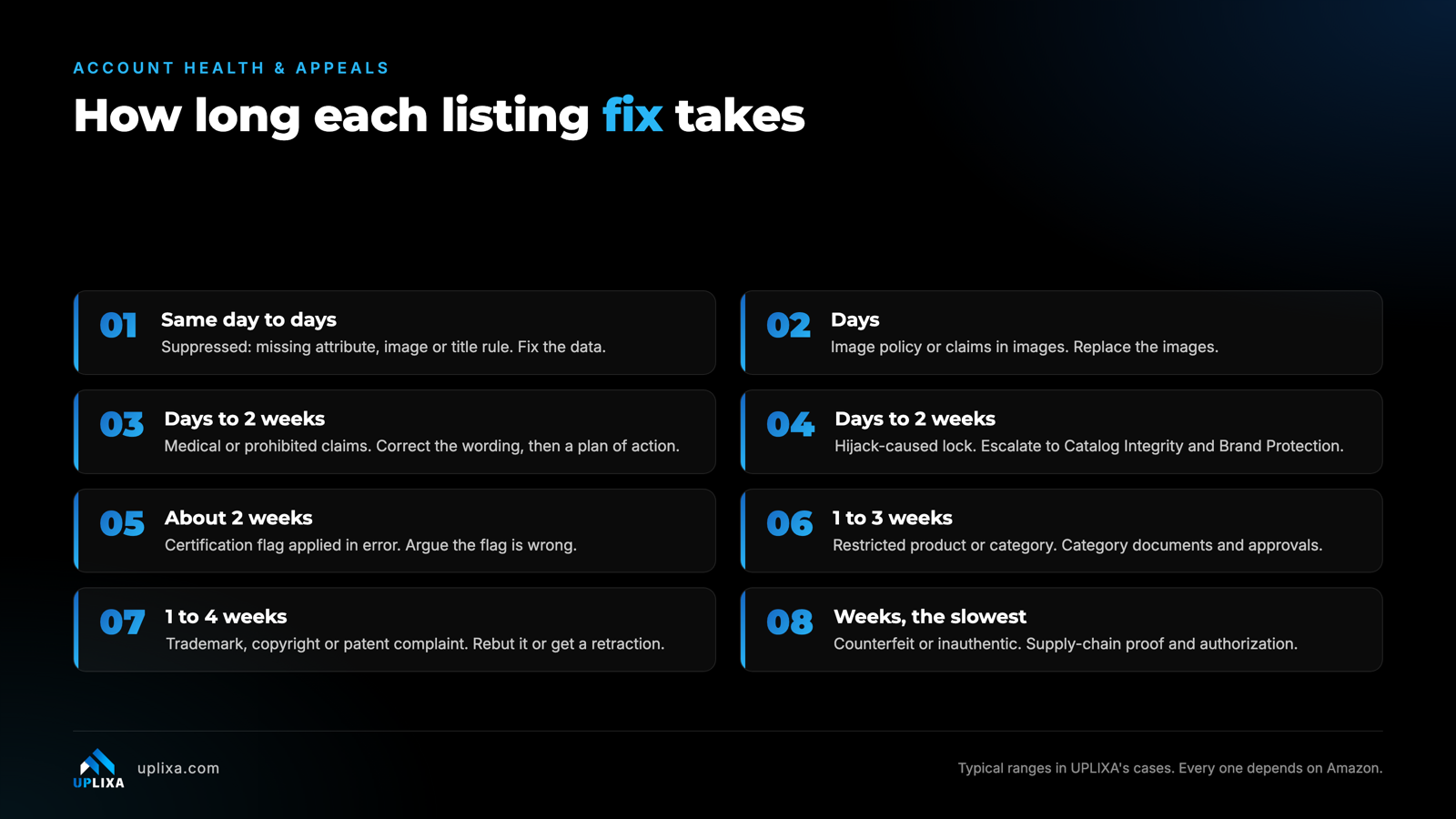
These are the ranges we’ve seen across our cases. Every one depends on Amazon. Amazon decides, not us.
| What happened | What Amazon wants | Typical time in our cases |
|---|---|---|
| Suppressed: missing attribute, image or title rule | Fix the attribute; no appeal needed | Same day to days |
| Image policy or claims in images | Compliant replacement images | Days |
| Medical or prohibited claims, structure/function misuse, “FDA approved” | Wording corrected across title, bullets, A+ and images, plus a plan of action | Days to 2 weeks |
| Restricted product or category | Category documents and approvals (OTC approval, COA, labels) | 1 to 3 weeks |
| Certification flag applied in error (organic, for example) | An argument that the flag is wrong | About 2 weeks |
| Trademark, copyright or patent complaint | A non-infringement case or a retraction from the complainant | 1 to 4 weeks |
| Counterfeit or inauthentic | Supply-chain proof: manufacturer invoices, authorization | Weeks; the slowest |
| Hijack-caused lock (brand field overwritten) | Escalation to Catalog Integrity and Brand Protection | Days to 2 weeks |
Why does the same kind of case take days for one seller and weeks for another?
Four things stretch a case in our experience:
- Routing. A compliance case dropped into generic Seller Support gets re-routed, and in our cases that adds five or more business days. File a hijack-caused lock with Seller Support and the script tends to close it as a rebranding request.
- The reply clock. If Amazon asks for more information and nobody answers within 10 business days, the case can close in our cases. Reopening starts the queue again, and we’ve seen that cost 10 to 20 business days.
- The marketplace. In our cases a US decision usually takes 3 to 7 business days; in Germany, France, Italy and Spain, 7 to 14.
- The reviewer. A template rejection adds a round, sometimes several. Evidence attached from the first submission is already there when a reviewer who reads documents picks the case up.
Is a deactivated listing an account problem?
Usually not. One listing is a listing case.
The exception is a pattern. When several listings go inactive in the same week, we treat it as an account-level signal: we stop filing per-listing cases and look at Account Health first. So, separate listing cases won’t fix a cause that sits at account level.
Where this goes wrong
Treating “Inactive” as the reason. It’s the status. The reason is inside the SKU, in Account Health or in a notification.
Appealing a suppression. A missing attribute needs the attribute. Skip the plan of action.
Filing a lock with the wrong team. A hijack-caused lock belongs with Catalog Integrity and Brand Protection.
Letting the reply clock run out. Ten business days pass quickly when you’re waiting on a supplier’s document.
From our case files
Proof: a certification flag applied in error
The Natural Charcoal Company (UK). The brand was hijacked, and an organic-certification demand was blocking about 400 units at the same time. Certification was impossible. We removed the hijacker first, then argued the organic flag had been applied in error, because “Natural” is part of the brand name. Amazon removed the violating contribution without any certification. The listing was reactivated and the stock released, about 15 days end to end. That’s the “certification flag applied in error” row above, running close to the two weeks we’d expect.
FAQ
What does “search suppressed” mean on Amazon?
In our cases it means the listing still exists but buyers don’t find it, usually because a required attribute, image or title rule isn’t met. Find the reason on the SKU in Manage Inventory, fix the data, then check search again.
Can I fix a suppressed listing myself?
Often, yes. Missing attributes, image problems and title problems are fixed on the listing, with no appeal. Policy removals, complaints and locks need a case with evidence.
How long does Amazon take to reinstate a deactivated listing?
In our cases, days to two weeks for claims problems, one to three weeks for restricted products, and weeks for counterfeit complaints. It depends on Amazon and on the marketplace.
Is a deactivated listing the same as a suspended account?
No. A deactivated listing is one ASIN. Suspension is account language, and account cases go to a different Amazon team. We reinstate listings and ASINs. We don’t take on seller-account reinstatement.
Why does Seller Central say Active when buyers see “currently unavailable”?
That’s what we call a suppression: the back end says active, the page doesn’t show. Look for the reason in Seller Central. If no reason appears anywhere, open a case and ask Amazon to state it.
About UPLIXA. UPLIXA is a compliance-first Amazon agency founded in 2021. We have worked with 80+ brands across the US, UK and Germany and handled 5,000+ listings across our services, from compliance and listing reinstatement to brand protection and brand name recovery.