Amazon supplement brands create parent-child relationships to group products with differing characteristics, such as flavors, sizes and or formats, under the same product family. Improper creation of parent-child relationships leads to catalog errors, listing errors, confusion among customers and compliance issues.
This blog discusses the most common parent-child listing issues in supplement brands and related catalog and compliance risks. Also provided are practical solutions to audit variation relationships, resolve listing inconsistencies and ensure accurate product information on child ASINs.
What are Parent-Child Variations on Amazon?
A parent listing represents a main product family, and child listings are components of the family. Each child ASIN is supposed to represent a legitimate variation of the parent product, and contain relevant variation information.
Supplement variations may include:
- Flavors
- Sizes
- Forms (tablets, capsules, powder)
- Serving size
- Other product differences supported by Amazon.
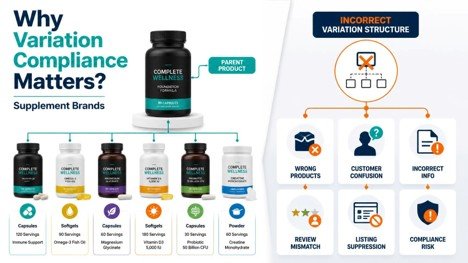
Summary: This infographic highlights the importance of Amazon supplement variation compliance. It explains how incorrect parent-child relationships can lead to wrong product variations, customer confusion, inaccurate listings, review mismatches, listing suppression, and compliance risks. Proper variation management helps supplement brands maintain accurate product information, improve customer experience, and protect listing health.
Common Amazon Supplement Parent-Child Listing Errors That Create Catalog and Compliance Risks
The following errors are ones that Amazon supplement sellers need to find and correct to correct catalog issues, address valid product variations, and lessen compliance risks.
1. Grouping Products as Variations When They Are Not Related
The most common mistake is grouping products together as variations when they are in reality different products. For example, having several different products or supplements grouped as variations is incorrect. Related variations must be described by the same attribute. Before creating a variation family, make sure products are related and would qualify for the variation relationship selected.
2. Using the Wrong Variation Theme
Amazon has defined variation themes based on the product type and category. Using the wrong variation theme can cause issues with the catalog and compliance. The variation theme must be aligned with the difference between the parent and child products.
Common Examples
- Flavor
- Size
- Count
- Color
- Style
- Pack Size
3. Creating Variations That Do Not Represent Real Differences
A child listing should have a legitimate difference from other children within the same family. Creating artificial variations to combine listings can lead to a catalog structure that is incorrect. Sellers should not create variations based on differences that are not physical differences of the product.
4. Mixing Different Supplement Formulas
This is especially relevant to dietary supplements. Two products may have similar packaging but completely different formulas. These differences should be reviewed before the products are logically combined under a parent-child relationship.
- Active Ingredients
- Ingredient Quantities
- Serving Sizes
- Supplement Facts
- Intended Uses
- Formulations
5. Inconsistent Product Information
This information should remain consistent across all child ASINs. These inconsistencies may also lead to customer confusion.
Common inconsistencies may include:
- Different names
- Incorrect flavor
- Different serving sizes
- Incorrect capsule/tablet count
- Mis-matched Supplement Facts
- Net Quantity
- Incorrect pictures
- Different claims
Parent-Child Listing Errors That Can Affect the Catalog
Incorrect variation relationships can create broader catalog problems beyond the individual listing. A clean variation structure helps ensure that Amazon’s catalog accurately represents the products being sold.
Potential issues include:
- Grouping products together incorrectly
- Catalog information that is redundant or contrary
- Incorrect variation attributes
- Inaccurate information on product detail pages
- Difficulty keeping correct Child ASIN information
- Confusion among customers when selecting a product
- Incorrect information shown among competing listings
How Incorrect Variations Can Create Compliance Risks
Inconsistent variation does present challenges for supplement brand products listed on Amazon. However, it does not necessarily imply non-compliance. The added burden for supplement brands is processing additional changes to ensure product data remains precise and consistent.
Potential risk areas include:
-Mismatches in product info and product packaging
-Different formulas presented under the same variation
-Unsupported, and/or inconsistent claims
-Incorrect information in Supplement Facts
-Old product images
-Incorrect product attributes
-Inconsistent information among child ASINs
Amazon Supplement Variation Audits and Listing Corrections: Key Steps for Compliance
A thorough variation audit helps supplement brands identify catalog inconsistencies, correct inaccurate product information, and maintain reliable listings across all child ASINs.
Step 1: Review Parent-Child Relationships
Ensure all child ASINs of the same product belong to the same eligible product family and meet Amazon’s variation requirements. Catalog unrelated product relationships through the appropriate process.
Step 2: Confirm Variation Themes and Attributes
Ensure the variation themes reflect the differences among the products. Confirm the attributes like flavor, size, count, and dosage form against Amazon’s requirements for the relevant product type.
Step 3: Verify Child ASIN Accuracy
Each child product listing must be reviewed to verify it reflects the corresponding supplement being offered for sale. The following aspects of the product must be reviewed:
- Product name, flavor, size, and count
- Ingredients and Supplement Facts
- Images and packaging
- Product claims, use, and warnings
Step 4: Match Listings with Current Product Labels
Compare and reconcile Amazon listing information with product labels and packaging. Update Amazon listing information for any new product labeling and packaging revisions.
Step 5: Resolve Catalog Inconsistencies
Resolve any incorrect, conflicting, or inappropriate variation relationships, and product details using Amazon’s catalog editing or support processes. Ensure any changes made comply with Amazon’s variation policies.
Step 6: Keep Product Records Up to Date
Retain documentation and supporting information to verify product listings and provide evidence to support listing information during Amazon’s verification processes. Evidence may include product labels, Supplement Facts, or other quality or test documents.
How UPLIXA Helps Supplement Brands Maintain Accurate Listings
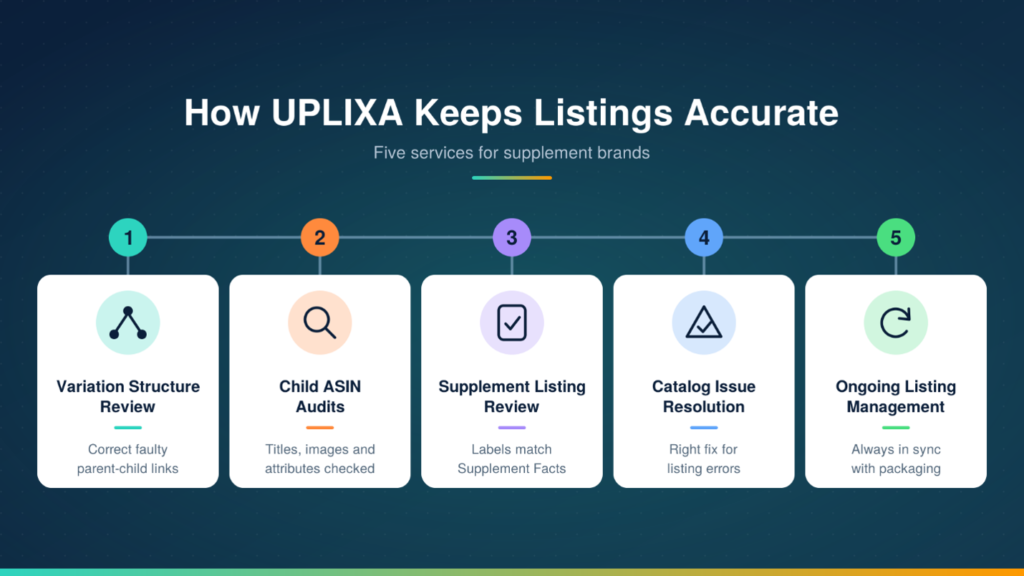
Brands often change their catalogs by introducing new product formulas or altering existing ones. Management of variety relationships can get complicated with the evolving catalog of a brand. The UPLIXA approach to account and listing management helps brands systematically resolve catalog problems, as well as inconsistencies in listings, including product details pages.
Final Thoughts
Parent-child variations make Amazon supplements listings easier for customers to navigate. Providing the correct parent-child relationships can be challenging at times; however, incorrect relationships can create unnecessary catalog and compliance issues. When creating or modifying a variation family, a supplement brand needs to review child variation relationships and variation themes as well as formulas and Supplement Facts, claims and images. Ensure that all the information for a product variation is consistent and accurate and that this information is consistent across all child ASINs to reduce customer confusion and unnecessary listing and compliance issues.