A supplement seller updates a product listing. Adds a new health benefit to the bullet points. Suddenly, the listing disappears from Amazon search. Product hasn’t changed. The ingredients are the same. But Amazon’s flagging the listing for a claims-policy violation.
Sometimes the issues are obvious. “Cures arthritis.” Others times, not so much. “Supports joint health,” for example, can get a listing pulled. So what supplement claims put listings at risk? What can sellers say instead? The answer is dependent on three things: what the claim is, is there scientific evidence to support it, and what Amazon’s requirements are for the product.
1. Which Supplement Claims Can Get Amazon Listings Removed?
There are prohibited claims for medical conditions, prohibited claims for disease treatments, prohibited claims for drug comparisons, and numerous other claims that would put listings at risk for non-compliance, especially for supplements.
- Disease Treatment or Prevention Claims
Dietary supplements generally cannot be advertised as products that diagnose, treat, cure, alleviate the symptoms of, or prevent diseases.
- Comparisons to Prescription Drugs
Comparisons of a supplement to prescription medication can be considered drug comparisons and would result in a non-compliant listing. There are countless other examples of drug-like comparisons that are prohibited.
Examples:
“Works like prescription weight-loss medication”
“Prescription-strength pain relief”
“Natural alternative to antidepressants”
- Misleading Approval and Performance Claims
Other statements can also create problems when they are inaccurate or unsupported. Amazon also restricts misleading ingredient quantities, unsupported certifications, and disease-related search terms. The important distinction: A claim does not become acceptable just because it avoids an obvious medical term. Amazon considers the meaning and the impression of the claim and the listing.
Examples:
“FDA Approved”- Most dietary supplements are not required to be FDA approved to sell.
“Clinically Proven”- This term requires scientific support.
“100% Pure”- This requires absolute purity.
“Legal Steroids”- This implies the product can have effects of anabolic steroids.
2. What Supplement Claim Wording Is Safer on Amazon?
The FDA states examples of qualifying claims to support a structure/function claim for a dietary supplement. These claims are communicating a benefit to a bodily function.
“Supports normal immune function” is a different claim than “Prevents influenza.”
Note: Each statement must accurately describe the product, be supported by scientific evidence, and be compliant with all Amazon and FDA policies. It is safer to not to make a claim at all if there is not evidence supporting the claim rather to make an unsubstantiated claim.
For example:
“Vitamin C Tablets- 60 Count”
This tells the customer what the product is without telling them what medical benefit they may expect.
3. Why Can "Supports" Claims Still Cause Amazon Compliance Problems?
Amazon names five supplement categories that need testing for heavy metals, microbial contaminants and known adulterants, on top of the cGMP proof every supplement needs: bodybuilding, joint health, sexual enhancement, sports nutrition and weight management.
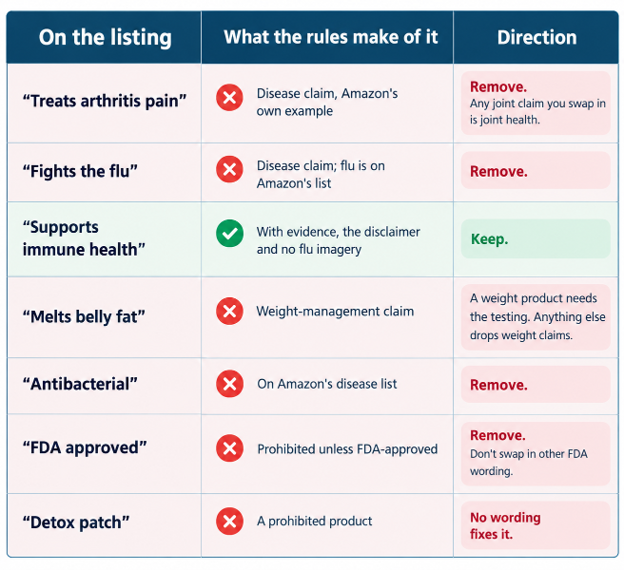
As reported from Amazon’s definitions, weight management covers products marketed to “increase metabolism or thermogenesis”. Joint health covers any joint health, flexibility or mobility claim. Even Amazon’s own structure/function example, “Promotes joint flexibility”, is a joint-health claim.
These are illustrations of the rules, not phrases we’ve seen pass:
Which Supplement Categories Have Additional Requirements?
These categories may require additional testing, verification, and documentation through recognized third-party providers. Applicable manufacturing requirements also remain relevant.
What sellers should understand: Changing listing wording does not automatically change the product’s category or remove its testing obligations. Before making changes, check the current category requirements in Amazon Seller Central.
Amazon’s US dietary supplements policy identifies five categories with additional standards:
- Bodybuilding
- Joint health
- Sexual enhancement
- Sports nutrition
- Weight management
4. What Does the FDA Allow Supplement Sellers to Say?
Amazon listing policies, and FDA regulations, are different sets of requirements. An assertion about a dietary supplement that is permitted by the FDA is not necessarily permitted on Amazon.
For dietary supplements in the US, qualifying structure/function claims must satisfy the following three conditions.
- The Claim Must Have Scientific Support
For any health-benefit claims, the statement must be truthful and not misleading, and be supported by evidence. The Federal Trade Commission (FTC) expects health-related advertising claims to be substantiated by competent and reliable scientific evidence. General ingredient popularity, customer reviews, or testimonials, are not evidence to support a health-benefit claim.
- The Product Label Must Include the Required FDA Disclaimer
For qualifying claims in supplement labeling, the following disclaimer is required.
“This statement has not been evaluated by the Food and Drug Administration. This product is not intended to diagnose, treat, cure, or prevent any disease.” The disclaimer must be accordance with the requirements of supplement labeling and formatting. It does not legalize a prohibited disease claim.
Notifying the FDA
The responsible party must notify the FDA within 30 days of first marketing the supplement with the qualifying claim.
This does not indicate FDA approval.
This information provides insight into why making a few minor changes to an Amazon listing is not a thorough approach to compliance.
5. Where Can Prohibited Claims Appear in an Amazon Listing?
Although sellers may have removed a problematic claim from a product title, that claim may still exist elsewhere in the listing. Amazon assesses product claims in the entire listing, including invisible bullet points and product descriptions.
A thorough review of a supplement claims should include:
– Title- claims containing references to diseases, exaggerated or drug-like benefits.
– Bullet Points and Description-implied or direct treatment claims.
– A+ Content- statements containing health-benefit claims, comparison charts, and promotional statements.
– Product Images, Infographics and Packaging- before and after comparisons, symptom and disease-related pictures and unsupported benefit claims.
– Packaging and Labels- ingredients and claims statements.
– Backend Keywords- restricted keywords and terms.
6. How Do You Fix an Amazon Supplement Claims Violation?
When Amazon suspends or deactivates a supplement listing, sellers should first investigate the specific reason for the action, rather than making numerous changes to the listing.
Sellers should take the following actions:
- Review the noncompliance Notice.
In the notice, determine if Amazon has flagged a claim issue, missing or incomplete product information, documentation, tests, or if the product is not allowed to be sold on the platform.
2. Identify the problematic statement.
Look over title, bullets, description, A+ content, images, packaging, and backend keywords. Identify disease treatment/prevention claims, direct or implied claims about another drug, and unsubstantiated claims. Look for discrepancies in product info
- Correct claim
Remove prohibited claims Where appropriate, replace with accurate, science based statements on normal body functions If no evidence is available, use factual product info instead.
- Verify product category
Check if supplement requires additional Amazon testing or verification. Don’t assume a copy edit resolves that.
- Submit correction or docs
Follow instructions in Amazon’s notice
Depending on the violation, this may require updating listing, correcting product pics, submitting test, presc. records, or appealing product classification. Some products can’t be sold on Amazon no matter how the wording is changed. For example, the policy in the US restricts dietary supplements and skin patches in the detox product category. The goal is to fix the policy issue rather than change words to avoid a policy violation.
- Do the Same Supplement Claims Work on Amazon UK and Germany?
Not always
A claim that is a structure/function claim in the US isn’t always permitted in other markets.
Amazon UK
In Great Britain, supplement health claims generally need to comply with the applicable authorized health-claims framework and its conditions of use.
An example of a broad statement such as “supports immune health” would require verification of the applicable authorized claim to determine if the product meets the conditions.
Amazon Germany
Germany aligns with the EU regulations on nutrition and health claims. Health claims are subject to the respective EU authorizations, and dietary supplements should not be advertised to treat a disease. Therefore, sellers who expand from Amazon.com to Amazon.co.uk or Amazon.de should verify claims for each marketplace. Translating a US listing does not equate to reviewing claims for regulatory compliance.
8. Final Checklist Before Publishing Supplement Claims
- Before publishing or resubmitting an Amazon supplement listing, confirm the following:
- Prior to publishing or resubmitting an Amazon supplement listing, ensure the following:
- Prohibited disease-treatment or prevention claims do not appear in the listing.
- All health benefit statements are supported by scientific evidence
- The listing does not contain misleading FDA approval or comparative drug claims.
- The quantity of each ingredient in the supplement aligns with the Supplement Facts.
- All images, packaging, and A+ Content have been reviewed.
- The listing includes the required category-specific tests and documentation.
- The claims comply with the rules of the targeted Amazon marketplace.
Final Thoughts
The best approach to be safe with Amazon supplement claims is not to simply replace aggressive claims with less aggressive ones. Replacing “supports joint health” with “maintains joint health” with “aids joint health” with “promotes joint health” with “strengthens joint health” with “boosts joint health” with “improves joint health” and so on may avoid an explicit disease-claim, but it may still require scientific support and/or be subject to other category-specific requirements. It’s best to focus on having accurate product descriptions, supported product benefits, compliant labeling and the documentation Amazon requires. There is no all-inclusive list of permitted supplement claims that’s guaranteed to satisfy Amazon’s review of claims. The wording has to be customized based on the product, evidence and the marketplace.