Understanding dietary supplement label requirements is critical for businesses selling dietary supplements on Amazon. Failing to properly label supplements can lead to several issues including verification issues, listing restrictions, negative customer reviews, and more.
Below, we highlight common dietary supplement labeling errors to help Amazon sellers understand where they may be exposing themselves to compliance risks.
Key Information Required on a Dietary Supplement Label
Dietary supplement labels must disclose important information including the product name, product ingredients, manufacturer information, and recommended product use.
Some of the label elements mentioned above include:
- The name of the dietary supplement
- Net quantity of contents (NQC)
- Supplement Facts panel
- Other ingredients
- Suggested use
- Warnings
- Manufacturer information
- Contact Information
- Servings and Ingredient information
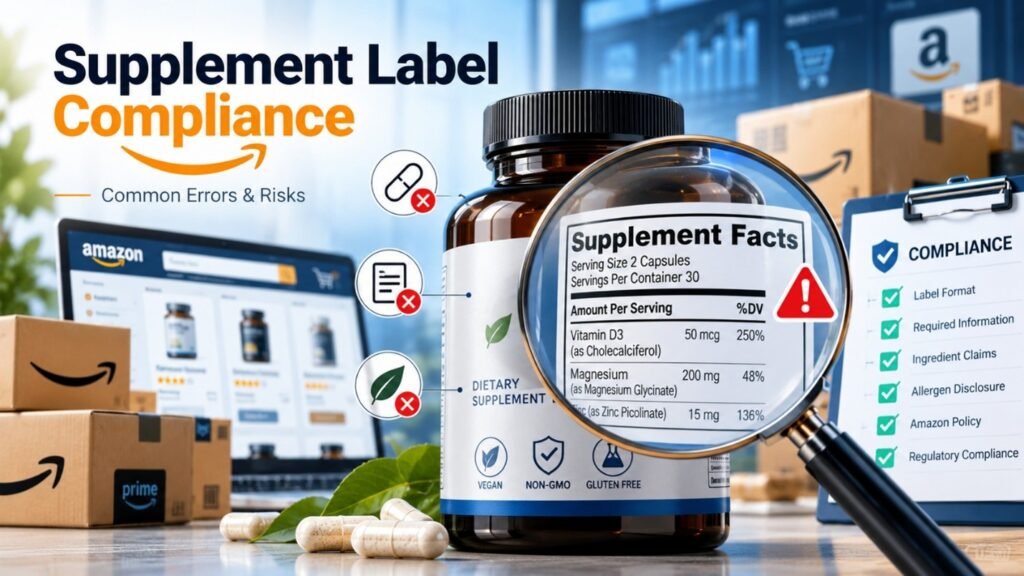
Common Dietary Supplement Labeling Errors and Compliance Risks for Amazon Sellers
Common mistakes on dietary supplement labels can slow down Amazon’s verification process, impose listing restrictions, or, in the worst case, result in product delisting. We have compiled the most frequent dietary supplement labeling errors below.
1. Mistakes in the Supplement Facts
The supplement facts panel must appear on the label of every dietary supplement and represent the formula of the supplement. Serving size and quantity of ingredients as well as Daily Value (DV) claims can lead to compliance issues if incorrect.
Some of the most frequent labeling mistakes include:
- Inaccurate serving sizes
- Missing ingredients
- Use of different units of measurement
- Incorrect DV percentages
- Information that is inconsistent with the actual formula
2. Incomplete, Outdated, and Inconsistent Information about Ingredients
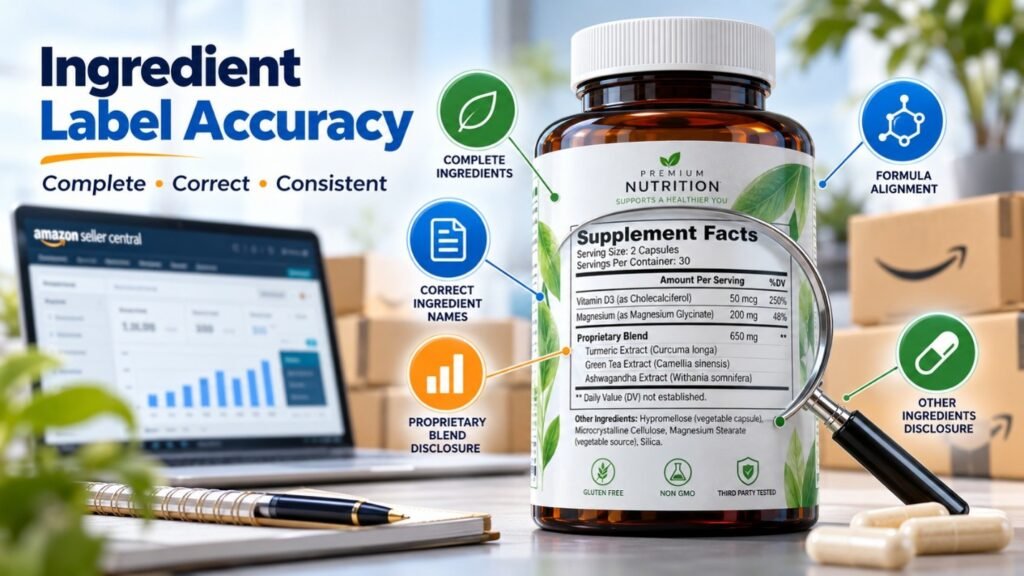
All ingredients in a dietary supplement must be disclosed on the label. Incomplete or inconsistent information may slow down or even prevent Amazon’s verification process.
In order to comply with Amazon’s requirements, brands must:
- Disclose all required ingredients
- Use the correct name of ingredients
- Reveal all ingredients in a proprietary blend
- Align label with the actual formula
- Disclose all other ingredients
3. Incorrect Net Quantity Statements
The net quantity statement informs the customer about the actual contents of a package. These statements must be consistent with the actual contents and be expressed using the correct units of measurement.
4. Lack of Manufacturer or Distributor Information
A dietary supplement label must be aligned with the requirements of the law and regulations and include the name of the responsible party. Labeling errors and omissions can create compliance concerns.
5. Unsubstantiated Health or Disease Claims
It is unlawful for supplement labels to make claims suggesting that a product can prevent, treat, or cure a disease. Unsubstantiated and misleading health claims can create serious compliance risks.
Some of the claims that warrant the most consideration include:
- Product claims that suggest they can treat or cure a medical condition
- Claims suggesting that a product can substitute prescription medication
- Claims suggesting that a product can prevent a disease
- Claims that suggest a guaranteed health outcome
- Misleading or exaggerated benefit claims
- Before and after claims
- Claims that are contrary to the actual properties of the product
6. Inconsistencies Between Product Labels and Amazon Listings
One major issue is when a product label and Amazon listing have inconsistent information. The information provided on Amazon should reflect the information on the product that the customer receives.
You should pay attention to differences in:
- Product name and flavor
- The amount of a serving
- The number of servings
- Net quantity
- Use directions
- Warnings
- Product claims
7. Outdated Labels After Product Changes
When a supplement brand changes its product formula or ingredients, and also changes the serving size without changing the supplement label or related product listing, there may be inconsistencies in label and listing information.
Before releasing a new product, a brand should review:
- The final product formula and formula updates
- Product packaging
- Supplement Facts
- Other ingredients
- Use directions
- Warnings
- Product claims
- Listing information on Amazon
- Supporting compliance documents
8. Label Design Issues that Affect Compliance
Clear and legible label design helps a customer find the required information. Label designs that contain too much or too little information may create compliance issues.
Common design issues include:
- Tiny or hard-to-read text
- Poor contrast between text and background
- Required information is hidden or unclear
- Label sections are crowded
- Incomplete statements
- Placing information in locations that are difficult to identify
- Packaging that obstructs or does not display the label
- Product images that do not show labels
9. Product Images That Do Not Accurately Show Labels
Amazon’s product images must show customers the actual product packaging. Images that misrepresent product packaging may lead to inconsistencies between the product and listing.
Check the following:
- The product image shows the correct, current product
- Label information is clear
- Product name is correct
- Label claims are correct
- Supplement Facts are provided without misleading or altering statements
- Images of product packaging that is no longer sold have been removed from the listing.
A Practical Process for Preventing Dietary Supplement Labeling Compliance Issues
A structured review process can help identify labeling problems before they affect an Amazon listing.
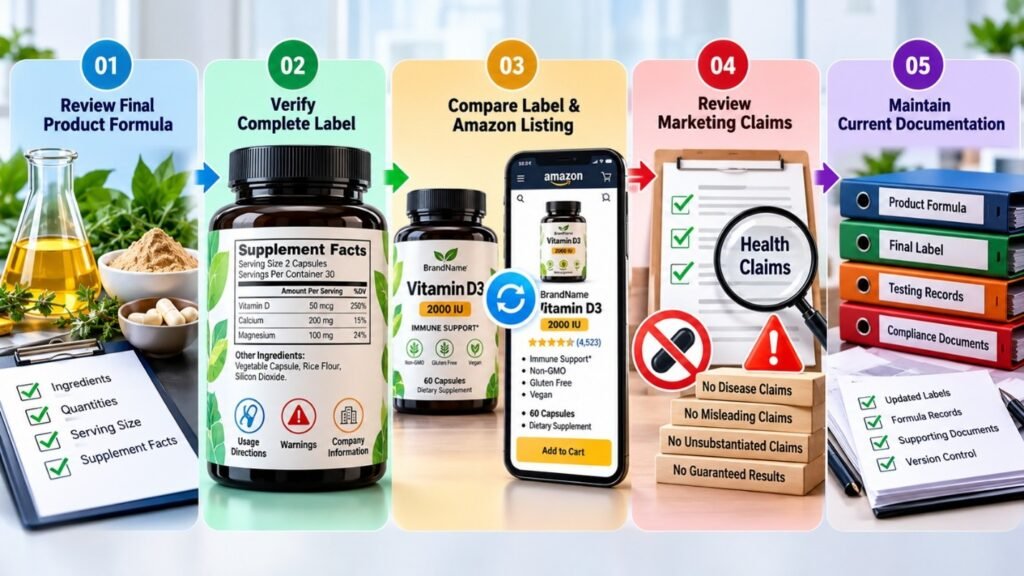
Step 1 : Review the Final Product Formula
Compare the current formula with the Supplement Facts panel and ingredient statement. Confirm that quantities, serving information, and ingredient names are accurate.
Step 2 : Verify the Complete Label
Review each part of the physical label, for example, the identity of the product, net quantity, Supplement Facts, ingredients, directions, warnings and company information.
Step 3: Compare Label and Amazon Listing
Check the physical label against the listing, i.e. title, bullet points, product description, A+ Content, images, and other content on the product listing.
Step 4: Review Marketing Claims
Review statements or representations that may be interpreted to be medical, disease-related, guaranteed, unsupported claims or unsubstantiated endorsements.
Step 5: Maintain Current Documentation
Retain the most recent label and associated product records to prove verification or compliance.
Essential Supplement Compliance Documents Brands Should Keep Updated and Organized
While specific records maintained may vary based on the product and situation, supplement brands should keep adequate records to support their products.
Examples of good records may include:
The records should be for the actual product being sold and support the claims being made for that product.
- Current product label
- Information for Supplement Facts
- Ingredient specifications
- Product formulation
- Certificates of Analysis (COAs)
- Documents related to GMP
- Records for manufacturing or facilities
- Supplier documents
Final Thoughts
Dietary supplement labeling is an important aspect of product compliance on Amazon. There are many opportunities for errors in supplement facts, ingredient information, net quantity, company info, product claims, or inconsistency between label and listing. These create significant verification and compliance risks. It’s important for brands to review the final formulation of the product, label, listing, product images, claims, and supporting documents. This can help find issues that may affect the product listing. It’s also very important to ensure that all the information listed above is current, accurate, and consistent. This helps brands easily respond to Amazon when they request supporting verification or compliance documents.