Selling on Amazon, you have to be careful with how you present your product. You have to be mindful of how you use product images, labels, and health claims. Product images, health benefit images, ingredient claims, health and clinical statement images, certifications, and images referencing the FDA, as well as images with medical visual representations can be concerning and can create Amazon compliance issues.
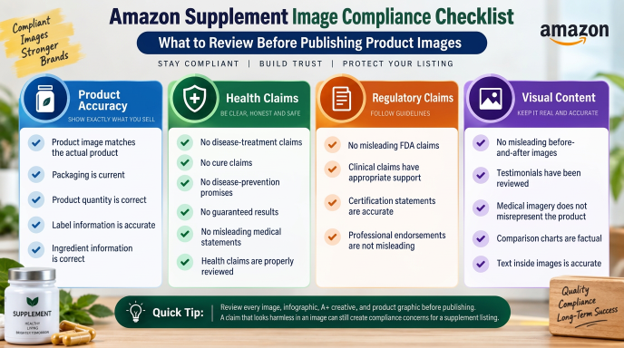
This blog will show you some important things to look at before publishing supplement images related to product information and related to images that can trigger a listing issue and includes product images, health and ingredient claims, labels, FDA statements, testimonials, and visuals.
What Does Amazon Supplement Image Compliance Mean?
Amazon supplement image compliance means accuracy and alignment of your supplement listing visuals, including the primary product image, with Amazon’s requirements
Type of Visual Content | What It Includes |
Main Product Image | Accurate product presentation |
Secondary Product Images | Additional product details |
Product Packaging | Current packaging and label |
Supplement Facts | Serving and ingredient information |
Ingredient Graphics | Ingredient-related information |
Infographics | Product benefits and key details |
Comparison Charts | Factual product comparisons |
Lifestyle Images | Product shown in relevant settings |
A+ Content | Enhanced product information |
Testimonials | Customer experiences |
Text Inside Images | Accurate and compliant messaging |
How Product Images, Labels, and Health Claims Can Cause Listing Problems
The images and claims on supplement listing product pages may create compliance issues if the images and claims are unsupported or misleading. Product images and unsupported health claims, labeling, health and ingredient claims, regulatory statements, and other aspects of the listing may present compliance issues. The following addresses some of the image and content issues that supplement sellers should consider prior to publishing their Amazon listing.
1. Images that do not represent actual product
Product images must show the actual product. In images that show the product, packaging that is outdated or inaccurate is confusing to customers and undermines the listing. Product images must be current.
2. Main Images That Contain Excessive Promotional Elements
Main product images should show the product with little to no promotional elements. Extra text, tags, and graphics reduce the image clarity and can be misleading. Clean, simple design should emphasize the product.
3. Health Claims That Suggest a Medical Function
Health Claims should not give a supplement the ability to cure, prevent, or mitigate disease and should be avoided. Strong medical claims may lead to serious compliance issues. Benefits of a product should be responsible and fair.
4. Ingredient Claims That Are More Than Truthful
Ingredient descriptions should accurately depict the product and should not be embellished or hyped. This helps the customer to not set unrealistic expectations.
5. Unsubstantiated Claims of “Clinical Proven,”
Terms such as “Clinically Proven,” “Doctor Recommended,” “Scientifically Proven” are very persuasive and are used to bolster a customer’s decision making. Such phrases should only be used if and only if there is substantial evidence to support such claims.
6. Incorrect or Inaccurate FDA Statements
FDA regulations should be adhered to and any FDA statements should not mislead a customer to believe the product has been endorsed. Such misleading statements can get a product listing banned.
7. Incorrect or Outdated Labels
Ensure that your images reflect the product currently being sold. Incorrect ingredient listings or outdated servings can be problematic and confusing. Always revise images when product listings, or packaging is updated.
8. Before-and-After Images and Guaranteed Results
Using before-and-after images or stating results that are guaranteed to happen can mislead customers. Don’t describe potential outcomes as if they always or usually happen unless you can defend that position. Product images should include benefits with responsibility and accuracy.
9. Testimonials and Medical-Looking Graphics
Testimonials with doctor images in a hospital or clinic along with related medical symbols and graphics can give the impression that the supplement is a medical product. These elements must be reviewed. The overall conveying of the image should not imply that the product is something that it is not.
10. Inconsistent Information Across the Listing
Whether it is an image, a label, a title, bullets or a description, everything related to your product should be consistent. Inconsistency in describing product details can cause customers to be confused and affect the accuracy of your listing. Review your listing in its entirety.
Final Thoughts
Attractive product visuals are essential, but compliance with the supplement image requirements extends beyond printed imagery and graphics. Images and labels should include health-related claims and graphic bones of product visual content that are consistent. Supplement sellers should carefully examine all images in supply chains that include health-related claims as well as statements in reference to the FDA and certifications. In addition, product information should be related to images, packaging, titles, bullets, descriptions and A+ Content in a consistent manner to enhance listing trust and to be complaint.