Appealing product descriptions aren’t the only aspect of an effective Amazon supplement listing. Every description of health benefits and product ingredients, workout claims and images, as well as supporting content, can all contribute to how Amazon evaluates product listings. For supplement sellers, poor claims can lead to compliance issues, listing suppression, or even enforcement by Amazon. Because of this, supplement sellers need to know the proper claims to use and how to use them without risking product listing compliance.
In this article, you will get supplement brands how to communicate product claims that are informative to customers, and that don’t unnecessarily risk product listing compliance.
What Are Product Claims on Amazon Supplement Listings?
A product claim is a statement that tells a customer what a supplement will do or what benefit they will get from using it. Product claims can be found in various parts of a listing, such as the product description, bullet points, A+ content, and images.
Some examples of product claims are:
- Immune support
- Digestive health
- Energy
- Sleep support
- Heart health
- Joint support
- Skin health
- General wellness
Why Supplement Claims Can Put an ASIN at Risk
Compliance issues can arise for supplements with claims that are false, misleading, overstated, and/or unsupported, as well as claims that do not comply with applicable frameworks and requirements.
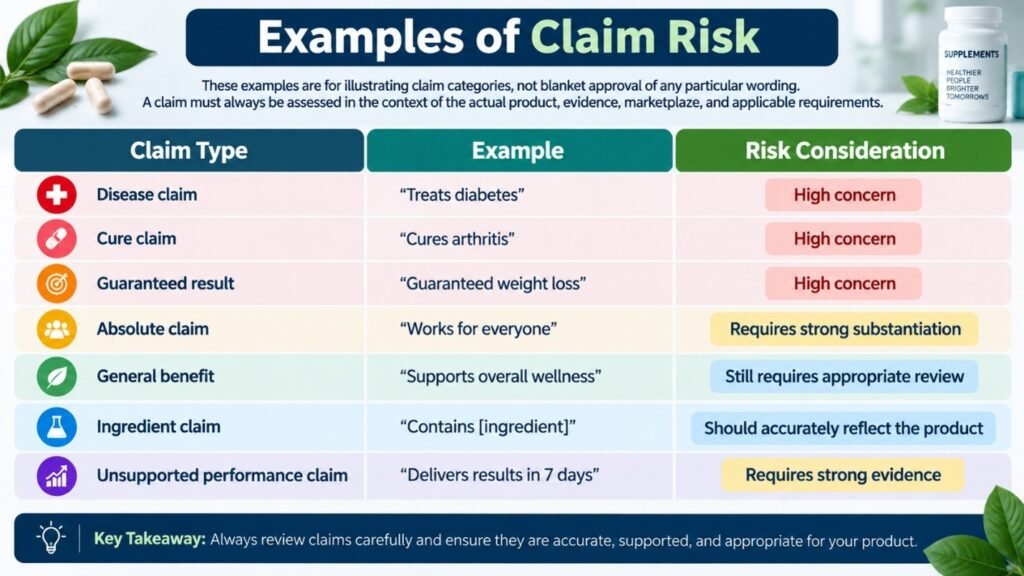
For example, the following statement creates a much greater compliance concern than a general wellness claim:
“Cures diabetes naturally”
closely associated with claims made regarding treatment of a disease and/or health conditions.
Similarly, claims such as:
- “Guaranteed weight loss”
- “Prevents cancer”
- “Treats depression”
- “Cures arthritis”
- “Reverses high blood pressure”
Process to Write Compliant Supplement Claims Without Putting Your ASIN at Risk
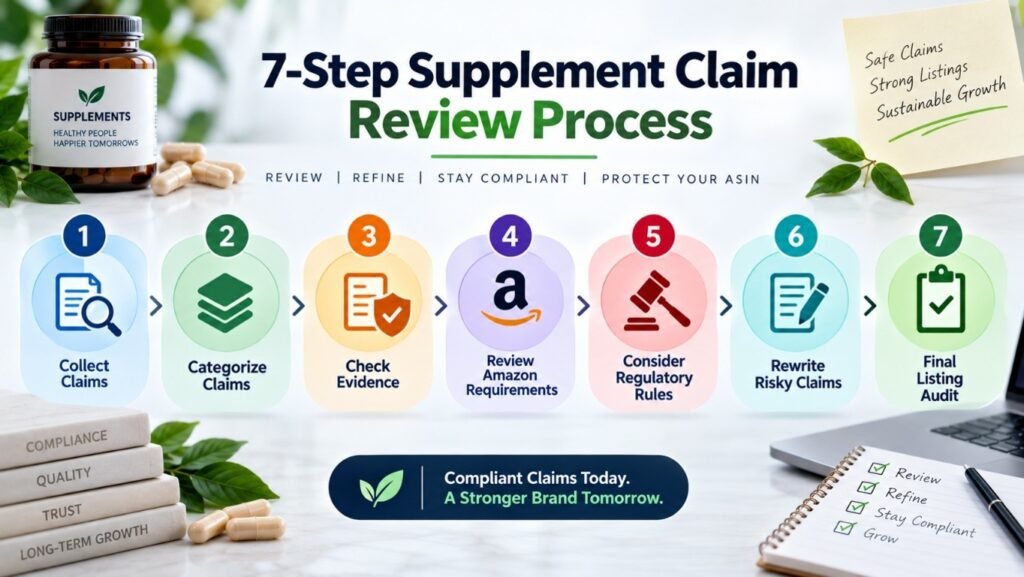
When it comes to supplements, the claims made can help boost the confidence customers have towards the product and improve listing compliance. Too bold or unsupported health claims run the risk of listing suppression or other problems for the ASIN. Making claims that are clear and justified can help reduce this concern.
1. Focus on the Product, Not the Result
Avoid claims that result in a particular outcome because the outcome may vary based on the person.
Avoid:
- “Lose 10 pounds in 2 weeks”
- “Guaranteed weight loss”
- “Instant results”
- “Works for everyone”
Do not make claims that guarantee a certain outcome.
Example:
❌ “Lose weight quickly with guaranteed results.”
✅ “Formulated to support your daily wellness goals.”
Do not overpromise and set expectations that your product can’t deliver.
2. Stay Away from Disease Treatment Claims
Supplements should not present themselves as solutions to treat, cure, diagnose, or prevent diseases.
High-risk examples:
- “Treats diabetes”
- “Cures arthritis”
- “Prevents heart disease”
- “Eliminates depression”
Using a softer word such as “supports” does not make a medical claim acceptable.
3. Make Sure Every Claim Relates to the Formula
Claims have to have a correlation to the ingredients and the formulation of the supplement.
Check the following:
- Does the product include the stated ingredient?
- Is the ingredient present in the correct amount?
- Is there product information that supports the above statement?
- Is the claim relevant to the product?
Do not replicate claims because they appear on competitor listings. A competitor’s wording is not evidence that the claim is appropriate for your ASIN.
4. Keep Proper Evidence Behind Important Claims
A supplement brand should have supporting information for claims used in its product marketing.
Useful documentation may include:
- Scientific research
- Ingredient specifications
- Product testing records
- Certificates of Analysis (COAs)
- Manufacturing documentation
- Product labels and specifications
The evidence should relate to the claim and product. A study about an ingredient used as part of a supplement does not support every claim associated with that product.
5. Review Claims in Every Part of the Listing
A claim can create compliance issues even though it is not written in the main product description.
Review all major listing areas:
Listing Area | What to Review |
Title | Health benefits and strong promises |
Bullet Points | Results, benefits, and performance claims |
Description | Detailed health-related statements |
A+ Content | Headlines, text, comparisons, and graphics |
Images | Text, badges, charts, and benefit claims |
Packaging Images | Claims shown on labels or containers |
Backend Keywords | Product-related terms and search language |
6. Check the Claim Before Publishing
When citing a supplement claim in the listing, consider:
- Does the statement relate to the product?
- Is the statement accurate?
- Are there external sources to support the claim?
- Is the claim so intricate that it could be interpreted as a medical claim?
- Is the claim the same in other sections of the listing?
Common Supplement Claim Mistakes That Can Put Your ASIN at Risk
There are several common mistakes in claims that may lead to a violation of ASIN. These include:
- Overpromising
The claims “instant results,” “100% guaranteed,” or “works for everyone,” for instance, usually increase the risk because they make broad claims that may be difficult to justify.
- Use of Medical Language
Any claims that include words that refer to diagnosing, treating, curing, or preventing a medical condition should be avoided.
- Following the Competition
Using a competitor’s listing as a compliance template or example is a violation.
- Lack of Evidence
Without evidence, claims should not be made.
- Ignoring Images
Images should also be included in compliance reviews and claims checked because visuals may contain textual content that is claims.
- Keyword Stuffing
There are several health keywords that, when added, increase search engine optimization (SEO) and may stack compliance.
A Practical Supplement Claim Review Process for Safer ASINs
A claim review process can be used to ensure a listing is compliant before publishing or amending a listing.
Step 1 : Collect claims
Collect claims from the listing by each section (i.e. title, bullets, images, etc.)
Step 2 : Categorize the Claims
Separate claims into categories as indicated below:
- General wellness
- Structure / function
- Ingredient related claims
- Performance related claims
- Disease related claims
- Weight loss related claims
- Treatment or prevention claims
Step 3 : Check Supporting Evidence
Examine claims and determine whether each is supported by reliable and substantiated evidence.
Step 4 : Review Amazon Requirements
Check the recently applicable Amazon policies and requirements for the relevant product category and marketplace.
Step 5 : Review Regulatory Considerations
Amazon compliance is an important first step, but supplement brands must also consider the applicable laws and regulations as they relate to product claims in their targeted marketplace.
Step 6 : Rewrite Risky Claims
Remove, revise, or replace unsubstantiated claims, as well as claims that are misleading, overly absolute, or inappropriate.
Step 7: Perform a Final Listing Audit
Examine the listing as a whole rather than individually to ensure accuracy and consistency in the final listing.
Final Thoughts
When attempting to optimize a listing, selling a product, or addressing a marketplace requirement, there is a fine line between marketing and passing a claim with supporting proof while managing the needs of an informed customer. Strong supplement claims on Amazon are direct and clear with no exaggeration for the ultimate benefit of the product. Natural descriptions and claims are often the strongest and the safest. Publishing a listing is the final step. The compliance of a claim should not be left to the judgment of the customer. To eliminate concerns for a listing, it is vital that, prior to publishing, claims are reviewed for each and every component of the listing. This component includes the written, visible claims, and each element that the customer has the opportunity to view and interact with (images, A+ Content, packaging, and more).