A US supplement brand that is successful selling on Amazon.com wants to expand to Amazon.co.uk and Amazon.de. The plan is to send the same product, and use the existing listing on Amazon.com, and translate the bullet points. Making listings in the other markets seems pretty straightforward, but the changes needed to meet the legal requirements can be substantial, especially in the labeling. The label could identify the product as a dietary supplement, the claims may be structured according to the US rules for structure and function, and the supporting documents may be prepared for the US process, which would be irrelevant to the European marketplaces.
In this blog, we will cover what differences sellers will face when shipping a product approved for the US marketplace to the UK and German marketplaces, including Amazon’s approval process, certificates of analysis, labeling, health claims, notifications, and other product requirements.
What Changes Between Amazon US, UK, and Germany?
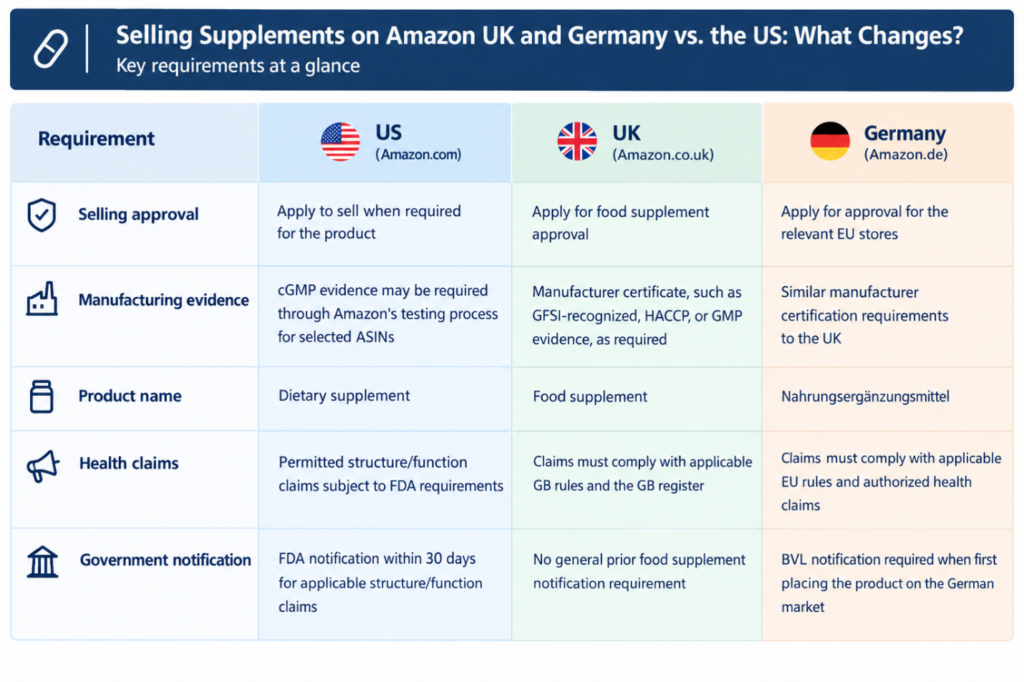
The requirements vary by marketplace, so a product approved for sale in the US is not automatically compliant in the UK or Germany. These are the main differences, but marketplace approval and legal compliance are separate responsibilities. Sellers must satisfy Amazon’s requirements and the applicable food regulations.
1. Why Doesn't the US Testing Route Apply in Europe?
Just because a US seller goes through Amazon’s dietary supplement testing process in the US, doesn’t mean they are exempt from completing the process in the UK and Germany. The US process may require the seller to submit a request for Account Health, and allow an authorized testing provider to evaluate the manufacturing records.
For both the UK and German marketplaces, the seller should go through the appropriate process, and supply the documents that are relevant to the marketplace.
- Making sure your product satisfies the requirements of the marketplace in which you are selling and has a legitimate, registered barcode.
- Applying for approval to sell food supplements.
- Selecting the correct type of product for the category template (ex. Health & Personal Care in the UK/ Drogerie & Körperpflege in Germany).
- Entering the food product information.
- Submitting the manufacturer’s certification for the ASIN, ensuring the certification is recent and the manufacturer and product covered by the certification are the same as the manufacturer and product for which the ASIN was generated.
Note: The crucial element is that no test report (or other documentation) will exempt a product from documentation. Sellers should always check the current requirements for their marketplace and their ASIN.
2. What Changes on the Label and in the Claims?
Products that can be sold in the US as dietary supplements may need changes before they can be sold in the UK and Germany as food supplements. There are three main areas of labeling that warrant special attention.
1. Product name and language
- The terminology of the product name varies by the region:
- US: Dietary Supplement
- UK: Food Supplement
- Germany: Nahrungsergänzungsmittel
In addition, the regulations of the marketplace may require that the label be in the native language of the region. Therefore, a product label made only for the US may need to be translated or relabeled to be sold in the UK and Germany.
2. Mandatory label information
Food supplement rules of the UK and EU established specific requirements for food supplement labeling. For instance, they may require: The recommended daily portion.
- Supplements are not to replace a balanced diet and a healthy lifestyle.
- Warning not to exceed the stated recommended daily portion.
- Keep out of reach of children.
3. Health claims and disease-related wording
US structure/function claims do not automatically qualify for use in the UK or Germany.
In Great Britain, health claims must comply with the applicable GB Nutrition and Health Claims framework. In Germany, claims must comply with the EU rules governing authorized nutrition and health claims. Food supplements must not be marketed using prohibited disease-treatment or disease-prevention claims. EU rules also restrict claims about the rate or amount of weight loss and certain health recommendations referring to individual doctors.
A direct translation does not make an unauthorized claim acceptable. Product titles, bullet points, descriptions, A+ Content, images, and packaging should all be reviewed for compliance.
3. Can You Use the Same Formula in All Three Markets?
Not necessarily. What is acceptable in the US may need additional regulatory review to be sold in the UK/Germany.
Vitamins, minerals, and ingredient restrictions
The EU rules determine permitted lists and forms for vitamins and minerals for use in food supplements. Ingredients not broadly consumed in the EU prior to 15 May 1997 may be subject to the Novel Food framework and, in the absence of an applicable exception or other legal basis, require authorization. Authorization for marketing in the EU does not mean the product is approved for the Great Britain market.
Amazon also has marketplace-specific product restrictions. For example, the UK supplements guidance identifies product restrictions on certain vitamin D products and products that exceed the stated daily limit. Prior to marketplace expansion, sellers should confirm that product attributes, ingredient amounts, intended use and product presentation are in compliance with the destination market.
Who is responsible for the product information?
There are differences market by market. For the EU, food information obligations fall on the food business operator under whose name the food is marketed (in the case where the operator is not established in the EU, the obligations fall on the importer), subject to applicable legal requirements. UK Amazon’s Foods Guideline also has similar requirements to the one stated earlier, which requires relevant business details, including the name and address of the responsible UK business or importer.
These requirements should be addressed prior to inventory being shipped, instead of after a product listing has been rejected.
4. Do You Need to Notify a Government Authority?
There are differences for government notifications for the three markets.
- Germany: BVL notification is required
There is a requirement to notify the Federal Office of Consumer Protection and Food Safety (BVL) when a food supplement is first placed on the German market, with a sample of the product label. This notification is required prior to marketing.
Complying with this notification process is separate from the seller approval process for Amazon.com.completing Amazon’s seller approval process does not comply with the notification process with BVL.
- United Kingdom: No general prior notification requirement
UK guidance states that the UK has chosen not to require prior notification for food supplements generally.
Avoiding prior notification for food supplements does not change the requirements for product compliance, food law, labeling rules and restrictions, and Amazon’s marketplace requirements.
III. United States: Notification to FDA for applicable claims
In the US, a manufacturer or distributor using a qualifying structure/function claim must notify the FDA within 30 days after first marketing the dietary supplement with that claim. This is limited to claims and requirements of the US and does not relieve any other obligations of the FDA.
5. Common Mistakes When Expanding to Amazon UK and Germany
Several common mistakes are made when a seller first expands to the United Kingdom and Germany Amazon markets. These mistakes are usually made because the seller is not aware of the local labeling requirements. These avoidable labeling issues can be overcome by reviewing the local requirements before inventory is shipped and listings are created.
- Assuming the US testing process covers Europe: Each marketplace has its own approval and documentation requirements.
- Submitting an unsuitable certificate: A certificate may be expired, not be broad enough in scope, or not include the relevant manufacturer/product.
- Confusing notification requirements: Germany requires BVL notification, while the UK does not generally require prior food supplement notification.
- Translating claims word for word: A US claim may still be unauthorized under UK/EU rules.
- Checking the listing but ignoring the formula: An ingredient or dosage may require separate regulatory review even when the listing content appears appropriate
Final Thoughts
There is untapped potential for supplement brands in the UK and Germany. While the concept of listing translation is not new, the windows to capture this potential are quickly closing. Each individual marketplace is made up of different approval processes, labeling requirements, claim restrictions and documentation formats. Before going live, think about your product claims, formula, labeling, manufacturer certificates and notifications. The BVL Notification requirement is specific to Germany and pertains to the first time a supplement is placed on the market. A proactive review of these areas is vital in identifying areas that could lead to delisting, selling restrictions and unnecessary costs. Addressing these areas can also provide piece of mind for the supplement seller when going after new market opportunities.