
The days of creating an Amazon seller account, posting product listings, and passively waiting for customers to purchase your products are over. Competition has skyrocketed and so has the cost of advertising. Sellers are forced to adapt their strategies as the marketplace and Amazon’s policies are constantly evolving. The success of your Amazon business in the long run depends on product visibility, as well as the control of your Pay Per Click campaigns, your stock, and most importantly, the health of your account.
This guide gives an in-depth perspective of the benefits, the obstacles, the expenditure, and the future implications of Amazon Account Management versus Selling by Yourself to allow you to assess the best approach for your growth strategy and aspirations.
Understanding Amazon Account Management
Amazon Account Management is the outsourcing of the optimization and management of your seller account to experts or agencies. It is choosing to not do everything by yourself and having professionals grow the account for you.
These services typically include:
- Creation and optimization of product listings
- Search and optimization of keywords
- Management of PPC campaigns
- Forecasting and planning of inventory
- Campaigns of competitor analysis
- Monitoring account health
- Reports of performance
- Management of customer issues
Understanding DIY Selling
DIY Selling means undertaking all business operations necessary for running a successful business on Amazon. In the DIY selling model, industry knowledge and experience are a requirement, as control of all business processes is obtained. The time commitment is also significant.
The processes you will need to manage include
- Creation and optimization of product listings
- Keyword search and optimization
- Creation and management of advertising campaigns
- Management of inventory
- Management of customer service
- Management of compliance with policies
- Management of performance tracking and reporting
- Management of advertising costs and best offer calculations
Amazon Account Management vs DIY Selling — Detailed Comparison
This detailed comparison will help you evaluate which option offers better value based on your business goals, resources, and growth strategy.
Analysis Category | Amazon Account Management | Digital DIY Selling |
Time Investment required | Professionals perform all daily tasks such as managing product listings, ads, and account oversight. This allows more freedom and flexibility to dedicate your time to scaling your business. | All aspects of an Amazon sales account from product listings to customer support are done by the seller. This is the most time intensive option, hands down. |
Level of Expertise | Amazon selling professionals have in depth knowledge and understanding of Amazon’s policies, frequent algorithm changes, and market knowledge. This allows them to better optimize and manage their clients’ Amazon business and accounts. | A seller must learn all aspects of selling on Amazon on their own through self-teaching. This is the most time intensive option and potentially expensive due to the learning curve and early stage selling mistakes. |
Upfront Investment | Amazon Account Management has a service or management fee. This means the initial cost is comparatively higher than managing your own account. | As you are managing your own account, there is no management fee. This option also has the lowest cost of the three. |
Sales Acceleration | Professionals have strategies which, when used, grow sales through increased visibility and conversions. | Neither the skills nor the experience of the seller is a factor when it comes to sales. If the wrong strategies are implemented, sales could grow very slowly. |
Error Rate | Almost all listing, policy compliance, and other account management issues are errors in inexperienced account managers. These errors lead to suspended accounts. | There is a direct negative effect on account performance with even the most minor listing, ad, or management errors. |
PPC Performance | Advertisers use keywords and bidding strategies to optimize ads. This leads to improved ROI and reduced ad spend. | PPC performance relies on the seller’s experience and testing. An unoptimized campaign can lead to a loss of the ad budget. |
Profit Margins | Poor ad and pricing strategies can lead to a poor bottom line. Unoptimized pricing can lead to poor profitability. | Good ad and pricing strategies can lead to an improved bottom line. |
Scalability | Good specialists simplify managing multiple products across multiple marketplaces and allow your business to scale. | Internal capacity to handle the workload decreases as the business grows. |
Account Health | Specialists help keep accounts healthy by tracking metrics and addressing problems. | Poor self-account oversight leads to unaddressed problems that hurt the health of vendor accounts. |
Long-Term Growth | Good ad and pricing strategies can lead to sustainable positive business growth and a healthy bottom line. | Growth is achievable, but is usually unoptimized. The seller’s effort is the primary factor of a business’s long-term success. |
Key Benefits of Amazon Account Management vs DIY Selling
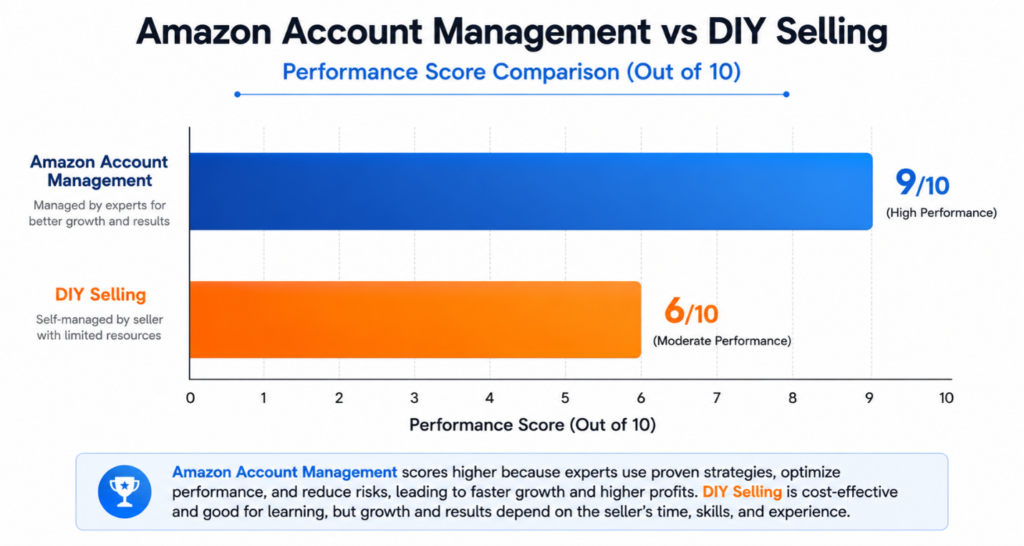
Every Amazon seller has different goals, budgets, and experience levels. The right choice depends on your current business stage, available time, and growth expectations. The comparison below helps you identify which option may suit your selling journey best.
Amazon Account Management | DIY Selling |
Saves time with daily management of account processes | Lowers starting costs (no management fees) |
Daily expert decisions because of access to data and trends | Fully control operations and strategies |
Easy PPC optimization with improved ad performance and ACoS | Good for learning the systems and processes of Amazon |
Revenue growth due to account optimization | Good for sellers with smaller budgets |
Lower suspension risk because of thorough compliance management | Flexibility to test and manage everything on your own |
Professional support helps grow your business easier | Good for beginners who want to learn by doing |
Conclusion
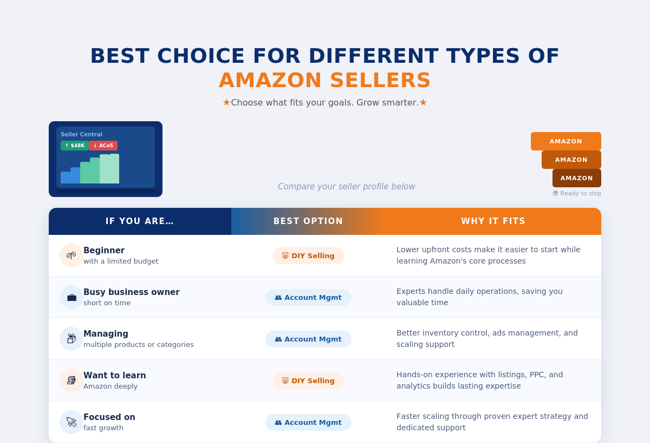
At the end of the day the decision to option for Amazon Account Management or DIY Selling comes down to your budget and the time you have. For the beginner, budget friendly and cost saving option, DIY selling is the best option to learn Amazon Selling operations. However, is cost effective, but time, effort and a high level of engagement are required.
Amazon Account Management, on the other hand, offers specialized support, strategy improvements, and quicker resolutions. For sellers looking for aggressive growth combined with increased profitability and scalability, Amazon Account Management is the better option. By employing specialized professionals, businesses can avoid error, improve account metrics, and better position themselves against the competition in an ever-changing market.